To use this heart rate zone calculator enter your age, resting heart rate (see below how to take your resting heart rate), and if you know it your maximum heart rate. Click calculate, to estimate your heart rate zones.
Beginners should always start in the lower zones (e.g. zone 2), and slowly increase exercise intensity as they become more fit. Read more about heart rate zones and how hard you should work out.
*Zone 5. Training in this zone will only be possible for short periods of time and is only for the very fit. This zone is reserved for workouts such as high intensity interval training (HIIT) and only the very fit are able to train effectively and safely within this zone.
The results of this heart rate zone calculator are estimated average values, and can vary according to fitness level, genetic predisposition, health, training volume, and other external factors. If you have any pre-existing medical conditions speak to your doctor about the best target heart rate for you.
This calculator derives target heart zones using the Karvonen formula, which is as follows:
Target Heart Rate = [(Maximum Heart Rate – Resting Heart Rate) x %Intensity] + Resting Heart Rate.
If you haven’t provided a maximum heart rate, a formula is used to estimate it. Research suggests that the commonly used Fox formula (MHR = 220 – Age) to determine maximum heart rate may overestimate heart rate in women.
Therefore, this calculator uses the Fox formula to determine maximum heart rate in men, and the Gulati formula (MHR = 206 – (0.88 x Age)) for women.1 That means the heart rate results for women will be lower compared to men.
If you prefer you can calculate your target heart zones yourself (click here for a step-by-step guide to calculating your heart rate zones), without the use of the target heart rate calculator.
YOUR HEART RATE TRAINING ZONE
Target heart rate or heart rate zones tell you how fast your heart should beat during exercise. Knowing your target heart rate range helps you ensure that you are exercising at the right level during your workout. It prevents you from exercising too hard, or not hard enough. It’s best to use heart rate in conjunction with other “tells” such as how you feel (see how to gauge exercise intensity).
To improve general fitness or to lose weight, try to perform longer duration exercise at around moderate intensity. According to the CDC, moderate-intensity physical activity is at a target heart rate of 64% to 76% of maximum heart rate.2 Basically step the intensity up to a level you are able to sustain for 30 – 60 minutes; this is your main target training zone. It’s roughly 60% – 80% of your maximum heart rate, which is zone 2 – 3.
If you have not exercised for a while, it is a good idea to start with a low to moderate intensity and increase it, as you get stronger and increasingly more fit. If you are fit, interval training, can be a very effective method of exercising to maximize fitness or weight loss.
| % of Maximum heart rate (MHR) | Intensity |
|---|---|
| 60 – 65% | Moderate |
| 65 – 70% | A little difficult |
| 70 – 75% | Moderately difficult |
| 75 – 80% | Hard |
If you are able, try to perform a mix of moderate exercise and high intensity exercise. This makes you fit in different ways, and also keeps your workouts interesting.
BEGINNERS
If you have been inactive for a long time, you may have to start at an intensity level lower than 60%. The more fit you become, the easier it becomes to exercise in your target heart rate (THR) range. It is also a possibility that your ideal exercise intensity may be higher than the target heart rate for your age group.
You know that you are working at the right intensity if you are sweating and breathing harder than normal, but not gasping for breath – this is called the talk test. The table below shows the level of fitness and its approximate corresponding maximum heart rate.
HOW TO MEASURE YOUR HEART RATE
For your resting heart rate, count your pulse for 60 seconds as soon as you wake up in the morning – before you do anything. The formula used to determine your MHR is only a best guess and not a guarantee of your true MHR value. To determine your true MHR you should consider conducting a Stress Test.
You can take your pulse by feeling for it at your neck (carotid artery) or wrist (radial artery).
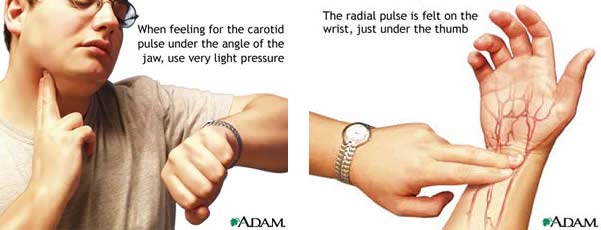
Taking pulse from your neck: Place your index & middle fingers on the carotid artery, which is just below the angle of your jaw at the side of you neck. Do NOT feel for both carotid artery pulses at the same time, as this can cause severe slowing of the heart.
Taking pulse from your wrist: Place your index & middle fingers on the radial artery, which is located on the lateral side (side of your thumb) of your wrist.